
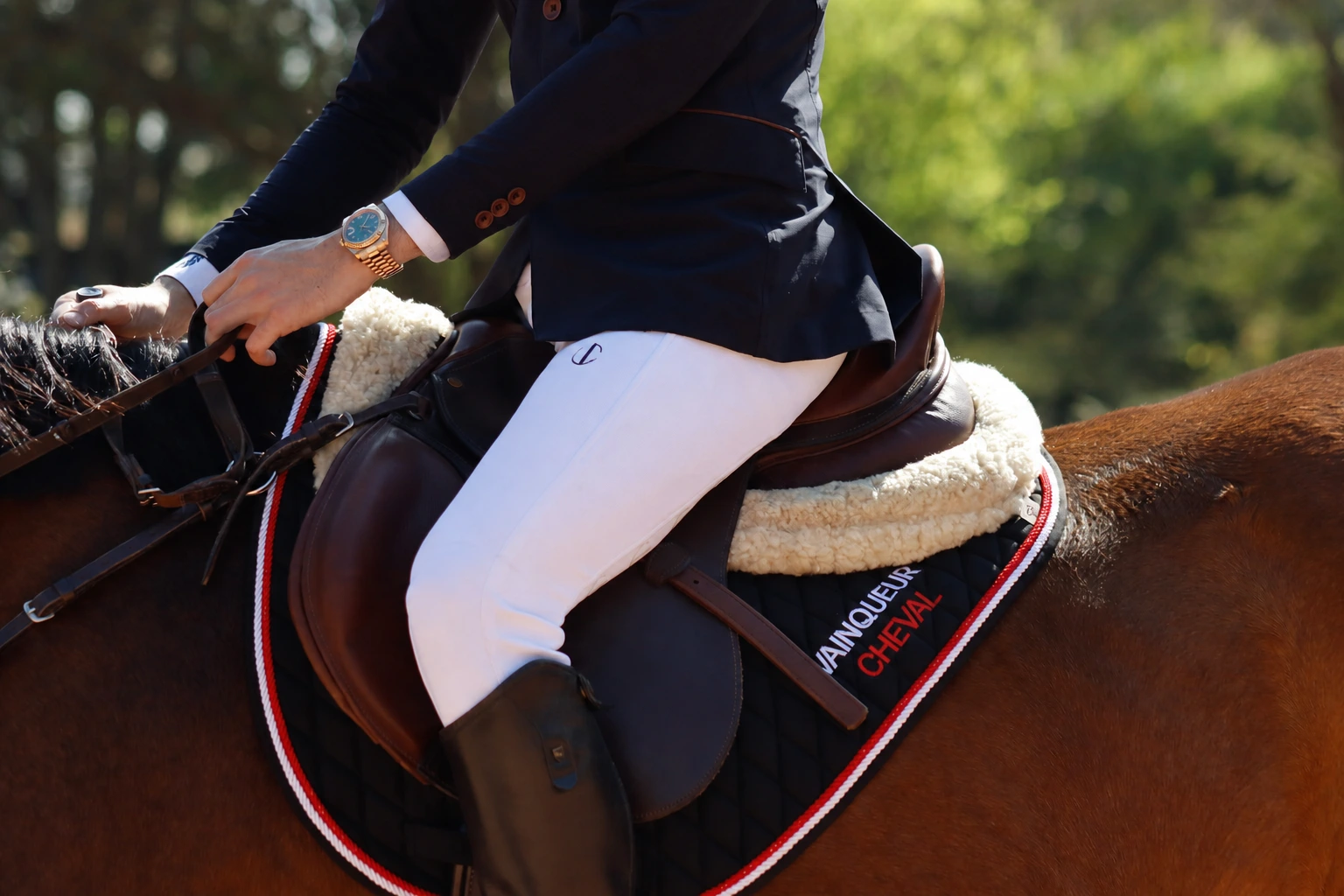
Standing fit is the beginning of an evaluation, not the end. The moment a rider shortens the reins or follows a jump, fabric is asked to move through the back, shoulder and elbow while the front of the jacket must remain composed.
This is why photographs taken with arms relaxed can be reassuring and incomplete at the same time. A competition jacket has to be assessed in the position where it will actually work.
The shoulders change first
As the arms travel forward, the shoulder blades separate and the upper back widens. A jacket that feels calm with the arms down may pull across the back, lift at the collar or restrict the reach once the rider takes a working contact.
The useful test is not an exaggerated stretch. It is the rider’s real posture: elbows softly bent, hands where they normally carry them and shoulders allowed to settle. The jacket should follow that position without a hard horizontal pull across the upper back.
Front balance is revealed in the saddle
Sitting changes the relationship between chest, waist and hem. If the jacket is too tight through the torso, the fronts may separate or the buttons may carry visible strain. If it is too long or poorly balanced for the rider, the hem can bunch instead of falling cleanly.
A closed jacket should still read as one continuous line. Small diagonal folds are a normal part of movement; fixed distortion around a button or a front edge that persistently turns outward suggests that the base size or balance deserves another look.
Sleeves must be judged with bent elbows
Sleeve length measured with a straight arm is only one reference. Bending the elbow draws the sleeve upward and changes how much shirt cuff appears. That is the view spectators and judges are more likely to see.
The goal is not to eliminate every millimetre of movement. It is to avoid extremes: sleeves that swallow the hand when standing or climb so high in riding position that the proportion feels unfinished.
Jumping and dressage ask different questions
A show-jumping rider moves through a larger range, from an upright approach to a forward seat over the fence. A dressage rider remains more vertical, yet the arms and upper back still need freedom while the jacket falls cleanly over the saddle.
The discipline does not replace correct sizing. It helps define the movement test. A jacket should be checked in the posture, saddle and shirt the rider normally uses, not in an abstract pose borrowed from another discipline.
A five-minute saddle check
Wear the usual show shirt and breeches. Close the jacket. Sit in the saddle, take the reins and move both hands forward. Check the collar, upper back, front buttons, cuff and hem. Then ask someone to photograph the front, side and back while you hold a natural riding position.
Those images are more useful than a sequence of stiff fitting-room poses. They show whether the jacket supports the rider’s line at the precise moment appearance and function have to coexist.
Choose the right kind of correction
Length and base size solve different problems. If shoulders, chest and balance are wrong, shortening a sleeve or hem will not repair the foundation. Start with the safest complete Vainqueur size; consider eligible sleeve or jacket-length adjustments only after the body of the jacket is working.
Fit is not the absence of movement. It is the ability to move without losing the intended silhouette.
With an official Vainqueur size, the free guided validator helps choose the base and eligible Personal Fit changes cover sleeve and jacket length—not the complete pattern. An individual Adult or Junior order can instead choose made to measure, with an individual pattern based on guided measurements reviewed after purchase. Explore the made-to-measure process.