
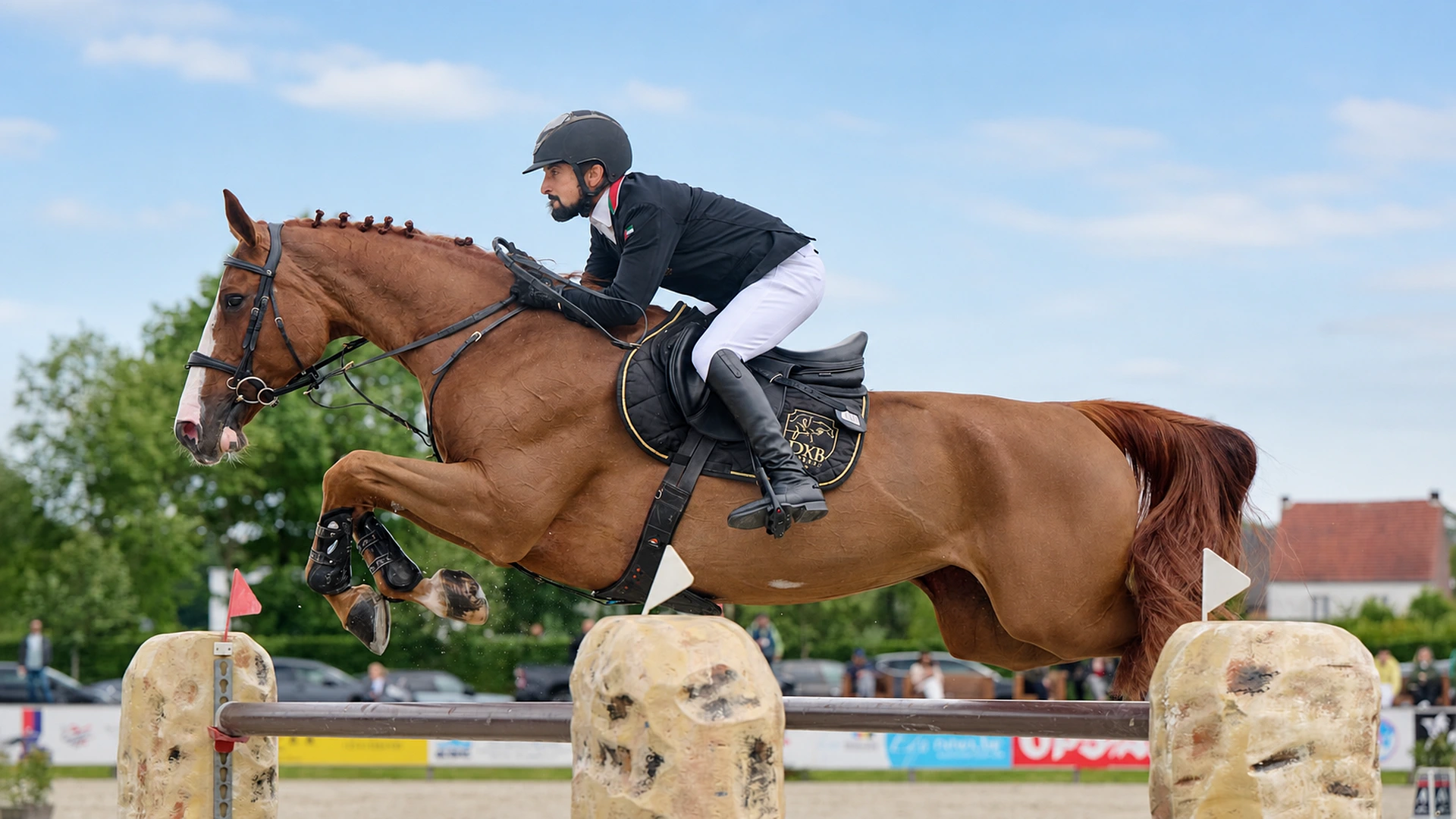
The fitting room offers stillness: shoulders level, arms relaxed, jacket closed. The arena immediately removes it. Hands travel forward, the torso inclines, the seat leaves the saddle and the jacket must keep its visual order while the body changes shape.
This is why a competition silhouette cannot be judged by a single front view. It must remain coherent through movement.
The shoulder begins the conversation
When the arms move toward the horse's neck, the shoulder line is asked to travel without pulling the entire front out of place. Enough freedom supports the gesture; excess volume creates noise. The goal is not looseness, but controlled mobility.
The hem should follow, not fly
At take-off, the torso angle changes quickly. A hem that is too rigid can push away from the body; one without structure can collapse. Length, vent behaviour and fabric response need to work together so the lower line follows the rider rather than becoming a separate movement.
Sleeves are judged with bent elbows
Sleeve length is often checked with the arm relaxed, yet reins are held with the elbow flexed. The cuff must remain intentional in that working position and connect cleanly with glove and shirt. This is where a technically correct measurement becomes a visual decision.
Details accelerate in motion
Piping, buttons and embroidery are repeated across a moving surface. What feels subtle on a hanger may become much louder as angles change and light catches each point. Restraint protects clarity: one leading detail, others supporting.
A photograph reveals another truth
Movement is often remembered through one frame. Photography freezes the instant when jacket, rider and horse are furthest from the fitting-room pose. A well-resolved silhouette still reads as one complete shape, even when every line is under tension.
Fit is not restriction
A close fit can be mobile; a loose fit can still pull. The distinction comes from proportion, construction and where room is placed. The aim is not to immobilise the garment, but to make its movement quieter than the rider's action.
This complements a technical fitting guide: measurements establish the base, while motion confirms whether the design belongs to the sport.
The final test is a sequence
Stand, close the jacket, raise the arms, take the rein position and observe the back, shoulder, sleeve and hem together. No single checkpoint defines success. The silhouette is the relationship between them.
A competition jacket earns elegance when it does not ask to be noticed at the most athletic moment. It frames the rider, follows the movement and lets performance remain the subject.
The authorised Vainqueur image illustrates jacket behaviour in motion. This essay makes no claim about the pictured event, horse or result.