
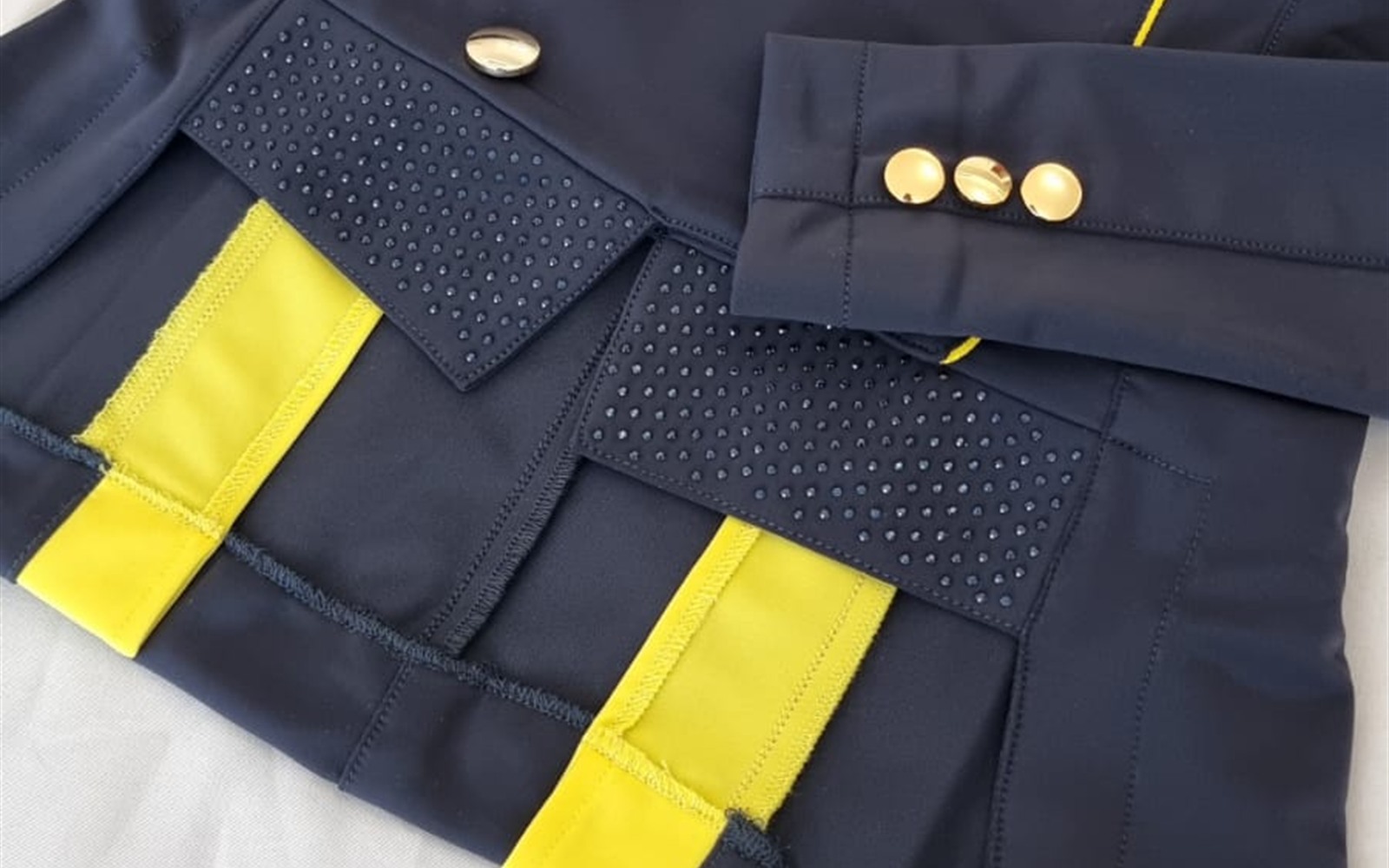
The eye usually meets a competition jacket at the collar and buttons. It understands the silhouette lower down. Around the waist, pockets and hem, several small decisions decide whether the jacket feels lifted, grounded, elongated or compact.
This area is easy to treat as leftover space. In a resolved jacket, it is an architectural line of its own.
The waist establishes the horizon
A jacket needs a point where the upper body appears to settle and the lower line begins. That point is not created by one seam alone. It emerges from the relationship between shaping, button placement, pocket height and the curve toward the hem.
Move one element and the others change visually. A pocket set too high can crowd the button line; set too low, it can make the jacket feel longer and heavier. The useful question is not whether the pocket looks good in isolation, but whether it reinforces the intended proportion.
Pockets can be quiet and still carry character
A straight welt, a shaped flap or a contrasting edge each gives a different direction to the eye. Horizontal emphasis can widen the lower torso. A diagonal or gently shaped line can connect the waist to the hem with more movement.
Decoration increases that authority. Piping, crystals or a contrasting flap turn the pocket into a visible punctuation mark. When the collar and buttons already lead strongly, the pocket often works best as a supporting voice.
Function must be decided before ornament
Not every pocket is intended to carry the same object—or to carry anything at all. Depth, opening and closure depend on the model and its purpose. That decision belongs early in the design process because a functional pocket has weight and structure; a purely visual line can be lighter.
Neither choice is automatically superior. What matters is honesty: the construction should match the expected use instead of promising function through appearance alone.
The opening beneath the jacket changes the silhouette
Below the waist, the front must separate cleanly as the rider sits. The angle and length of that opening influence how the hem meets the saddle and how much of the inner construction becomes visible in movement.
A glimpse of contrasting colour can be intentional, but it should remain connected to the jacket's complete palette. What is hidden while standing may become a recurring accent in the arena.
The hem finishes the argument
Pockets organise the middle; the hem decides where the jacket stops. Its curve, length and relationship with the hip determine whether the lower half feels abrupt or continuous. This is why hem length cannot be separated from the rider's proportions and riding position.
The best lower line does not look busy even when it contains several decisions. Pocket, waist, opening and hem appear to arrive at the same conclusion.
Review the jacket from a distance
Close-ups are useful for checking stitching, trim and finishing. They can also make every detail seem equally important. Step back and the hierarchy becomes clearer: where the eye pauses, whether the pockets tilt the silhouette, and whether the lower half supports the collar and shoulders above it.
That distance test matters because a competition jacket is experienced across an arena before it is inspected at arm's length.
Balance is designed through relationships
A memorable pocket does not need to be loud. It needs to belong to the button line, the waist and the hem. When those relationships are deliberate, the lower half gives the entire jacket composure.
The result is not an accumulation of features. It is a silhouette in which each detail knows where to stop.
The authorised Vainqueur production photograph is cropped for the page while preserving every visible garment detail. It illustrates design principles and does not attribute an athlete, event or result.